
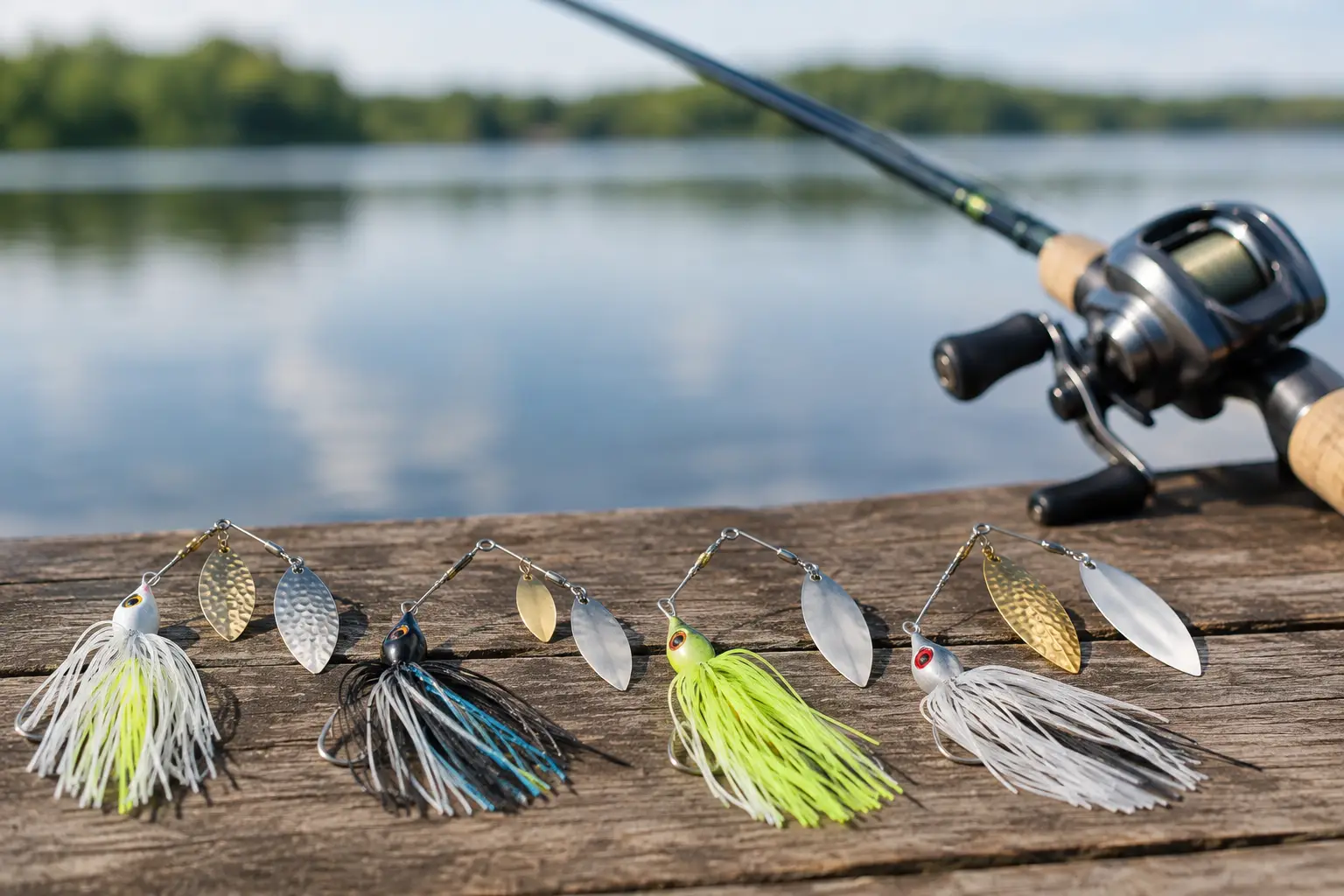
A spinnerbait can run right through places that eat other lures, but only if the blades are doing the right job. This spinnerbait blade selection guide is built for the moments when you know bass are around wood, grass, docks, or riprap, yet your bait is either coming through too fast, hanging too high, or getting ignored.
Blades are not just decoration. They control how much vibration the fish feels, how much flash it sees, how high the bait rides, and how slowly you can work it. Get that mix right and a spinnerbait becomes a big-fish tool from dirty-water prespawn banks to clear-water shad chases.
Spinnerbait Blade Selection Guide: Start With Water
Before choosing a blade, look at the water. Visibility tells you whether bass are likely to find the bait with their eyes, their lateral line, or both. Then consider wind, current, cover, depth, and forage. Those details decide whether you need a blade that pushes water hard or one that flashes like a fleeing baitfish.
In muddy water, at night, or under thick cloud cover, vibration usually matters more than fine flash. A rounder blade gives fish a stronger target to track. In clear water with active fish, a narrower blade can look cleaner and let you cover water quickly without overpowering the presentation.
Do not treat this as a hard rule. A big Colorado blade can still catch clear-water bass when a cold front has them tight to cover and unwilling to chase. A willowleaf can produce in stained water when wind creates enough surface chop to hide the lure and bass are feeding on shad. Blade selection gives you a starting point, not handcuffs.
Know What Each Blade Shape Does
Colorado blades bring thump and lift
Colorado blades are the round workhorses. They start turning easily, throw a heavy pulse, and create plenty of lift. That lift lets you crawl a spinnerbait slowly over shallow grass, alongside laydowns, or through dark water without burying it in the bottom.
This is the blade to reach for when you want a bass to feel the bait before it can see it. Think muddy creeks, runoff, low-light mornings, nighttime banks, and cold water where a slow retrieve gets more bites. A single large Colorado can be especially good when you are fishing tight targets and want to keep the bait in the strike zone longer.
The trade-off is speed. Push a big Colorado too hard and it can make the bait roll, rise too quickly, or look like it is working overtime. That is not always bad, but it is less suited to burning open-water flats.
Willowleaf blades deliver flash and speed
Willowleaf blades are long, narrow, and made to run fast. They produce less drag than a Colorado, so they keep a spinnerbait deeper and allow a quicker retrieve. Their tight rotation also creates a strong flash that resembles a school of baitfish scattering.
Use willowleaf blades when bass are feeding on shad, when the water has decent clarity, or when you need to cover a lot of water. They shine on windy points, over submerged grass, around docks, and across long stretches of bank where a reaction bite is the goal. Double willow setups are a favorite for clear to lightly stained water because they look fast, clean, and baitfish-like.
The downside is that willow blades do not push as much water. In chocolate milk conditions, a bass may not locate them as easily unless you are running the bait close to likely cover.
Indiana blades split the difference
Indiana blades have a teardrop shape between a Colorado and willowleaf. They offer more thump than a willow while staying more streamlined than a Colorado. If you only want one middle-ground option for changing conditions, an Indiana blade is a solid choice.
They work well in stained water, around shallow cover, and during those middle-of-the-road days when the water is not dirty enough for maximum vibration but not clear enough for a pure flash presentation. An Indiana also gives you a little more flexibility in retrieve speed than a big Colorado.
Oklahoma blades are a useful sleeper option
Oklahoma blades, sometimes called mag willow blades, carry more body than a standard willowleaf. They give off extra pulse and flash without the full drag of a Colorado. When bass want a bigger profile around shad but you still need to keep the bait moving, this shape earns its place.
They are especially useful in lightly stained reservoirs, on windy days, and in areas where bigger bait is present. If a regular willow setup feels too subtle and a Colorado feels too slow, an Oklahoma can be the answer.
Match Blade Finish to the Sky and Water
Blade shape gets the bait found. Blade finish helps it look right once a fish is close.
Silver is the everyday choice for shad, bluegill flash, and clear to moderately stained water. It reflects light sharply and is hard to beat when bass are chasing. Gold gives off a warmer flash and often stands out better in stained water, tannic water, or under clouds. Brass and copper finishes can be good when you want a more subdued, natural look instead of a bright mirror flash.
Painted blades have a place, too. White, chartreuse, and orange accents can help fish key on the bait in muddy water or around shallow cover. A painted blade may also give a spinnerbait a bluegill flavor when bass are guarding fry or feeding around beds.
If you are unsure, start with silver in clearer water and gold in dirtier water. Then let the fish make the call. A few short follows without commitment can mean the flash is too much, too little, or simply the wrong color against that day’s light.
Tandem, Double Willow, or Single Blade?
A tandem setup usually pairs a smaller front blade with a larger back blade. This is one of the most versatile spinnerbait arrangements because the front blade adds flash while the rear blade supplies most of the vibration and lift. A small Colorado in front of a larger willow, for example, gives you a baitfish look with enough thump for stained water.
Double willowleaf is the choice for speed, flash, and schooling fish. It excels when you are burning a spinnerbait over grass, waking it just below the surface, or covering open banks where bass are feeding aggressively. It also comes through some vegetation cleanly because the blades do not create as much drag.
A single Colorado is about presence. It is made for slow rolling, nighttime fishing, dirty water, and close-quarter cover. Run it near a stump, let it helicopter down beside a dock post, then start it turning with a slow handle turn. That heavy blade can call a fish out from places where a fast double willow would pass unnoticed.
Blade Size Changes More Than You Think
A larger blade creates more lift, vibration, flash, and resistance. It slows the bait down, helps it stay shallow, and makes it easier to feel during the retrieve. That makes large blades useful for slow rolling shallow water and for getting a spinnerbait noticed in poor visibility.
Smaller blades reduce lift and drag. They let you fish deeper, faster, and tighter to the pace of small baitfish. They are often better when bass are pressured, water is clear, or you need to keep a spinnerbait down on a windy point.
Do not overlook balance. If the bait rolls on its side, skips across the surface when you want it deeper, or struggles to track straight, the blade combination may be too much for the wire frame and head weight. A well-built spinnerbait should run true at the speed you fish it. That dependable tracking is one reason anglers who fish hard demand hand-built tackle from makers like Hart Tackle.
Let Retrieve Speed Finish the Job
The same blades can fish very differently based on how you turn the handle. Slow rolling means keeping the blades barely turning near the bottom or just above cover. This is a strong move in cooler water, after a front, or when bass are holding on deeper wood and rock.
A steady medium retrieve is your all-around search pace. It keeps the bait tracking cleanly through laydowns, grass lanes, and dock edges. When a fish swipes and misses, keep the bait moving for a moment, then pause or change cadence before the next target.
Burning is for active fish. Use smaller Colorado blades, willows, or double willows and move the bait fast enough to force a decision. This works best when bass are feeding shallow, chasing shad, or using windblown water to ambush prey. The bite may feel violent because there is no time for a fish to study the bait.
When spinnerbait fishing gets tough, make one meaningful change at a time. Switch from silver to gold, move from double willow to tandem, or slow down with a larger Colorado. Give each change enough casts around likely cover to tell you something. The right blade is the one that puts the bait where the fish can find it and gives them a reason to strike.
